Deepen Pakistan AI policy
Key Objectives and Vision
The policy's big-picture goals include creating 3 million jobs by 2030, boosting GDP through AI exports, achieving 90% AI awareness among internet users by 2026, and building a $2.7 billion domestic AI market within five years. It emphasizes responsible AI to tackle socio-economic issues, promote inclusivity (especially for women, PWDs, and marginalized groups), and ensure data sovereignty. Rooted in Prime Minister Shehbaz Sharif’s Digital Nation Vision, it's phased: early focus on ecosystem building (2025-2026), then commercialization and global integration by 2030.
The Six Strategic Pillars
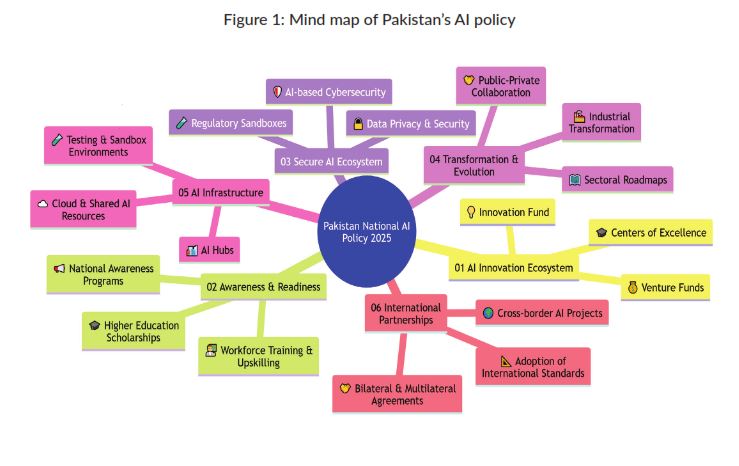
The policy is built on six interconnected pillars, each with specific strategies and measurable outcomes. Here's a detailed breakdown:
| Pillar | Description and Key Initiatives |
|---|---|
| 1. AI Innovation Ecosystem | Establishes a supportive environment for R&D, startups, and commercialization. Includes the National AI Fund (NAIF) for grants and investments, Centers of Excellence (CoEs) in seven cities (potentially including Peshawar for Khyber Pakhtunkhwa's tech push), and AI Innovation and Venture Funds. Aims to fund 1,000 AI ventures and convert academic research into products via accelerators and cloud support. |
| 2. Awareness and Readiness | Focuses on human capital: Train 200,000 people annually in AI/data skills, award 3,000 scholarships, provide 20,000 paid internships, and launch "Train the Trainer" for 10,000 trainers by 2027. Promotes nationwide AI literacy, including programs for marginalized groups, to position Pakistan as a global AI readiness leader by 2035. |
| 3. Secure AI Ecosystem | Ensures ethical governance with regulatory sandboxes (testing 20 enterprises by 2027), cybersecurity protocols, data privacy (via PECA amendments), transparency frameworks, and bias mitigation. Includes an AI Regulatory Directorate for oversight and human rights protections. |
| 4. Transformation and Evolution | Drives AI adoption in sectors like education, health, agriculture, and governance. Involves sector-specific roadmaps (rolling out 2025-2026), workforce upskilling, public-tech projects (50,000 targeted), and performance metrics for AI integration. |
| 5. AI Infrastructure | Builds national capabilities: A compute grid, centralized datasets, AI hubs, cloud resources, and HPC grids/sandboxes. Focuses on sovereign compute/data to reduce reliance on foreign tech. |
| 6. International Partnerships | Fosters global ties through joint research, cross-border projects, bilateral/multilateral agreements, and adoption of international standards. Aims for tech transfers and collaborations with AI leaders. |
Here's a mind map visualizing the pillars and their components:
Implementation and Governance
Oversight comes from a National AI Council (high-level strategy), a Policy Implementation Cell (day-to-day execution), and a master plan/action matrix. The Ministry of IT & Telecom (MoITT) leads, with Ignite handling commercialization (e.g., funding startups, accelerators). Related laws include the Prevention of Electronic Crimes (Amendment) Act 2025 (covers AI-manipulated content) and the pending Regulation of Artificial Intelligence Bill (establishes an AI Commission for penalties).
Funding Mechanisms
NAIF is the core, drawing at least 30% from Ignite's R&D Fund for predictable financing. It supports grants, ventures, and incentives to crowd in private/multilateral investments. Analysts praise this for being more structured than peers in South Asia.
Ethical Considerations and Security
Ethics are central: Fairness, transparency, human rights, and bias prevention are mandated. The policy uses sandboxes for ethical testing and aligns with global norms like UNESCO's AI ethics. Data governance emphasizes sovereignty and privacy under PECA.
2026 Progress and Updates
As of February 2026, key momentum includes the launch of Indus AI Week (Feb 9-15, 2026), announced in January, focusing on adoption through workshops, hackathons, and partnerships. It's operationalizing the policy with events in major cities—keep an eye out for Peshawar sessions if you're local. Training programs are rolling out, with early focus on public sector upskilling.
Challenges and Risks
Experts note risks like funding governance gaps (e.g., disbursement criteria), trainer shortages, regulatory overlaps, and under-specified data standards. Infrastructure and skills bottlenecks could delay timelines, especially in regions like Khyber Pakhtunkhwa. Recommendations include stage-gated funding and independent audits.
Regional Benchmarks
Compared to neighbors, Pakistan's policy is participatory and ethics-focused, with stronger funding than Bangladesh or Sri Lanka but less centralized than the UAE's. Here's a quick comparison table:

This policy could be a game-changer for Pakistan's tech scene, especially in Peshawar's growing startup ecosystem. For how it ties into advanced AI like agents, check our piece on Moltbook AI Agents: The Powerful Future. If you want more on a specific pillar or local implications, just say
Comments
Leave your comments below.